Please find below the concerts of our 2026-27 season!
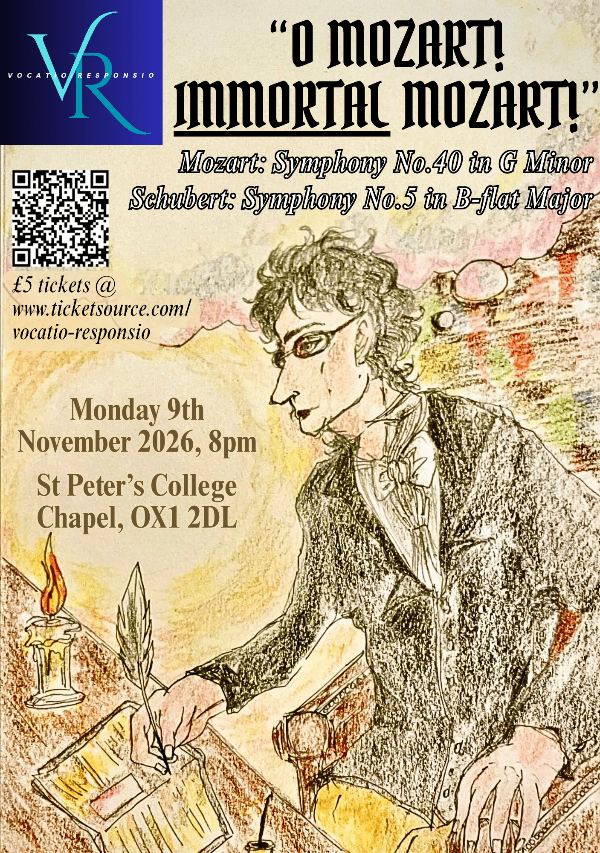
"O Mozart! Immortal Mozart!"
Monday 9th November 2026, 8pm
St Peter's College Chapel, Oxford, Oxfordshire, OX1 2DL
“All my life I shall remember this clear, fine, lovely day. I still hear softly, as from a distance, the magic strains of Mozart’s music. […] O Mozart, immortal Mozart, how many, how infinitely many inspiring suggestions of a finer, better life have you left in our souls!”
Written by Franz Schubert in his diary on the 13th June 1816, these words not only reveal the profound admiration the nineteen-year-old composer felt for Mozart, but also how Mozart’s symphonies were still the models to emulate. Just three months after this confession, Schubert began his work on his Fifth Symphony, and the comparison to Mozart’s music would be more than striking. With a lighter orchestration far removed from the larger-scale symphonic writing of Beethoven (who, by this point, had already composed eight of his revolutionary symphonies), and a cheerful character most glaringly associated with the Classical style, Mozart’s presence can certainly be felt in Schubert’s Fifth.
Of all of Mozart’s symphonies, his 40th in G Minor naturally offers itself as the best companion to Schubert: the connection is especially vivid in their minuets (both in G Minor), and Schubert made a copy of Mozart’s minuet to use it as a model for his symphony. But, while Schubert’s symphony is said to look back to these traditions, Mozart’s 40th often looks forward, with even early nineteenth-century critics even describing the work as “romantic”.
In Vocatio:Responsio’s curtain opener, we examine this curious, retrospective relationship that has been forged between Mozart’s Symphony No.40 in G Minor and Schubert’s Symphony No.5 in B♭ Major in as a meeting point for the ideals of classicism and romanticism: Mozart looks forward to a new age of musical expression, Schubert looks back to the “magical strains” of earlier music.
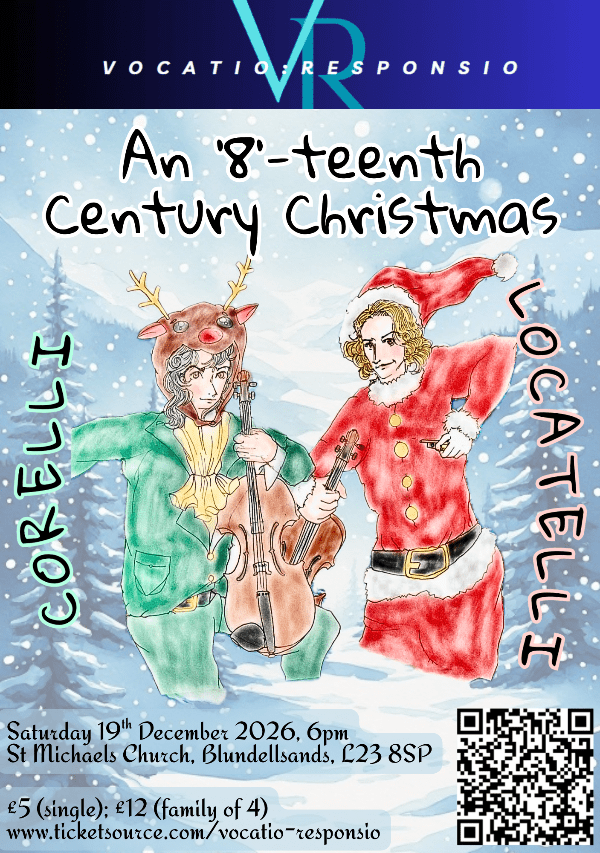
An '8'-teenth Century Christmas
Saturday 19th December 2026, 6pm
St Michael's Church, Blundellsands, Merseyside, L23 8SP
Arcangelo Corelli’s Twelve Concerti Grossi, Op.6 (1714) was one of the most commercial and widely distributed publications throughout Europe in the eighteenth century, its prestige cementing the work as the textbook for 'concerti grossi', music for a concertino group of soloists (here 2 violins and a cello) standing out among a ripieno group of strings with harpsichord.
Among the most famous of these twelve concertos was the eighth, which bears the inscription Fatto per la notte di Natale ("made for the night of Christmas") and contains a 'pastorale' movement to conclude the work. This 'pastorale', which recalls the Christmas music of the traditional Italian bagpipe and reed pipe, proved hugely popular and invited several imitations, including a concerto by Pietro Locatelli in his Twelve Concerti Grossi, Op.1 (1721). And in which concerto does this pastorale feature? The eighth, just like his countryman maestro did before him!
In Vocatio:Responsio's first EVER Christmas concert(!), this theme will be our primary point of departure as we explore Corelli and Locatelli's music alongside other examples of the pastorale across the early eighteenth century. But that won't be it: you can also expect a variety of Christmas music from all over Europe in that period, a special tribute to John Dowland as the 400th anniversary year of his death comes to a close, as well as sing-along carols for the whole audience to join in on!
Cultural Friendships – Couperin’s Fantasies
Tuesday 16th February 2027, 4:30pm OR 7pm
The Chapel @ 38 St Giles, Oxford, Oxfordshire
Couperin’s ode to whom he considered the “the greatest man in music” of the seventeenth-century was described by the composer as a “harmonic panegyric”, but would Lully himself have been impressed with this work in his honour? Truth be told, probably not: Couperin’s ambition of achieving a réunion des goûts between French and Italian musical cultures went against Lully’s disdain of the Italian style, and this piece serves as one of his most explicit teachings that musical perfection can only be accomplished through the reconciliation of the two styles.
Here, Italian music is represented by the figure of Arcangelo Corelli (who Couperin had composed a similar apotheosis for a year earlier), who meets Lully in the afterlife and makes music with him, merging their polarising styles together in what is called ‘La Paix du Parnasse’ [The Peace of Parnassus] as the union between cultures is achieved.
Vocatio:Responsio’s debut concert in the St Hilda’s College Early Music series will transport us into the fantasies of Francois Couperin, with a dramatic interpretation of his tribute to Lully and France, as well as Corelli and Italy, as we examine the place of Couperin’s ambition in the early eighteenth-century France, and perhaps most importantly, whether his réunion des goûts caught on...
Emanuele D’Astorga’s Stabat Mater
Friday 2nd April 2027, 7pm
St Michael-in-the-Hamlet Church, Aigburth, Merseyside
Join Vocatio:Responsio for their fourth concert of the academic year, a special, intimate feast of choral music at the St Michael-in-the-Hamlet Church in Liverpool. In this concert, Emanuele d’Astorga’s setting of the thirteenth-century Christian hymn Stabat Mater takes centre stage: first performed in Oxford in 1713, it is a musical depiction of the Virgin Mary’s sorrow at the Crucifixion. Vocatio:Responsio performed this work in January 2025 at the Holywell Music Room, and we are very excited to bring this wonderful, rarely heard gem to Liverpool audiences!
In addition, for the first time in the ensemble's history, we will also perform a world premiere performance of a new composition specially commissioned for Vocatio:Responsio. The work will be for choir and strings composed by Nick Samuel, a masters student reading Music (Composition) at St Anne's College in the University of Oxford.
John Blow's "Venus & Adonis"
Friday 7th May 2027, 8:30pm
Pusey House Chapel, Oxford, Oxfordshire
Saturday 8th May 2027, 2:30pm
Holy Trinity Church, Stratford-upon-Avon, Warwickshire
"Your kids are gonna love it!": Beethoven's Grosse Fuge
July 2027 (dates and locations TBC)
Reconstructions: J.S. Bach's keyboard concertos
Alexander McNamee, keyboard
Samuel Oliver-Sherry, violin
Wednesday 25th August 2027, 7:30pm
Liverpool Lighthouse Theatre, Everton, Merseyside
Friday 27th August 2027, 7:30pm
Canongate Kirk, Edinburgh, Midlothian
Saturday 28th August 2027, 7:30pm
Christ Church Morningside, Edinburgh, Midlothian