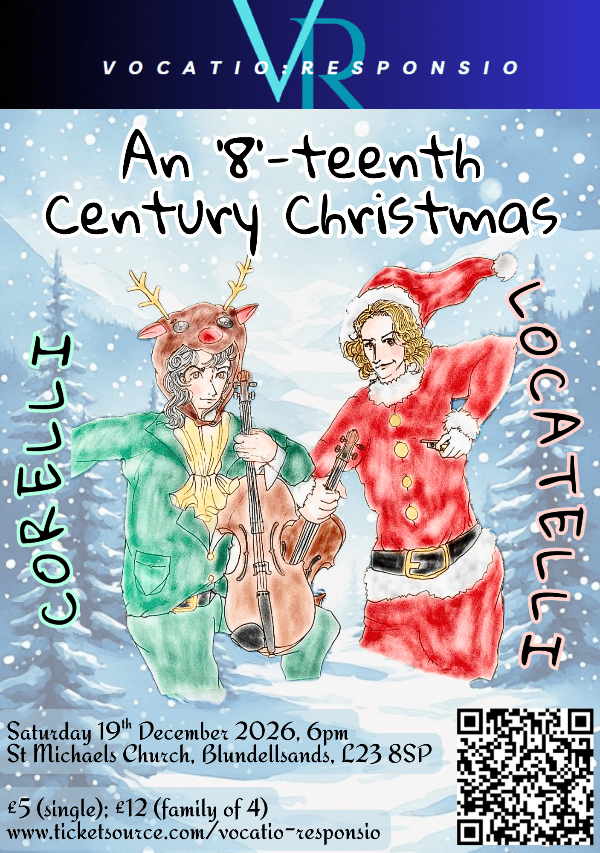
Please find below the upcoming events of our 2025-26 season!


Vivaldi: The Four Seasons

Monday 9th February 2026, 8:00pm
Pusey House Chapel, OX1 3LZ

Antonio Vivaldi (Venice, 1678 - Vienna, 1741)

  • Violin Concerto in E Major “Spring”, Op.8 No.1

  • Violin Concerto in G Minor “Summer”, Op.8 No.2

  • Violin Concerto in F Major “Autumn”, Op.8 No.3

  • Violin Concerto in F Minor “Winter”, Op.8 No.4

​Few works in classical music are as instantly recognisable or endlessly captivating as Vivaldi’s The Four Seasons, four violin concertos in which each and every note is so well-known, so well-loved all across the world, yet its familiarity often hides just how radical and imaginative it truly is. While listening to this music, Vivaldi’s composition may speak vividly on its own, yet through the journey tracing a full year in sound, transforming nature into music, there is a sense that each moment is being gently framed, as if an unseen hand is guiding a hidden narrative that may be out of sight, but is always present, always speaking, its voice being the music. 

In our first concert of 2026, Vocatio:Responsio warmly invites you to hear this masterpiece of eighteenth-century music through fresh ears, as we look forward to unearthing one of the greatest musical stories to stand the test of time. 

"In illo tempore": Scarlatti's St John's Passion

Monday 23rd March 2026, 8pm
St Matthews Church, Oxford, OX1 4LW

Wednesday 25th March 2026, 7pm
St Michaels Church, Blundellsands, L23 8SP

Giovanni Battista Sammartini: Sinfonia in A Major, Overture to ‘Memet’
Alessandro Scarlatti: St John’s Passion [John 18 & 19:1-37]

What is the difference between hearing something said and hearing something sung? At first glance, it would appear to be fundamentally very little: the presence of music gives varying tones and pitches to the speech of course, but surely that wouldn't be enough to change anything within the text itself. However, music not only affects the text, but dictates our whole understanding of what we are hearing, and what we are performing. That’s all thanks to the introduction of a third party, the composer, who does all the interpreting for us through their setting of the source. In the spoken word tradition, the interpretive process is usually carried out by the speaker themselves, creating a direct relationship with the text (as well as the author behind it) to inform their delivery of the words. However, the presence of a composer disrupts this link between author and speaker: in the case of this concert, the performer is presented with Alessandro Scarlatti’s imagining of John’s Gospel, and in their storytelling must subject themselves to interpreting Scarlatti’s reading and reproduction of John’s narrative.

Join Vocatio:Responsio as they aim to shine understanding on the first Passion setting written in seventeenth-century Italy, as well as a closer examination on music’s relationship with spoken text, how music affects our perception of the words we are hearing. 

N.B: for the second showing of this concert, 100% of the proceeds will go towards St Michael's Church's "Raise the Roof" appeal fund. https://stmichaelsblundellsands.co.uk